Guns N' Roses - Paradise City
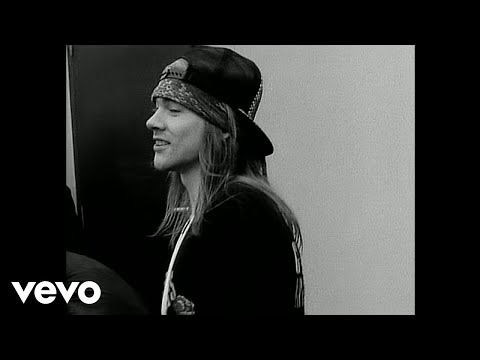
What this video is
Released in 1988 against the backdrop of the late-80s hard rock mainstream peak, 'Paradise City' captures Guns N' Roses at the precise moment of their crossover from Hollywood strip outsiders to global stadium headliners. The dual-location shoot — Giants Stadium on the Aerosmith co-headline US tour and the Monsters of Rock festival at Donington Park — visually documents the band's transatlantic breakthrough. The Donington footage is particularly weighted: two audience members died during the GN'R set, lending the footage a somber documentary significance beyond typical concert spectacle. The video's raw, vérité aesthetic stood in contrast to the glossy, high-concept productions dominating MTV in the same period, reinforcing GN'R's outsider authenticity at the precise moment of their commercial arrival.
Why it matters
A landmark artifact of late-80s hard rock music video grammar, 'Paradise City' codified the multi-camera stadium-concert-as-music-video format that would influence rock video production through the 1990s. Its rapid 1.92s average shot length and 213-cut structure established an editorial template for translating stadium-scale live energy into the compressed television frame, prioritizing crowd communion and band spectacle over narrative artifice.
The director
Nigel Dick (born 21 March 1953, Catterick, North Yorkshire, England) is a British-American music video director and filmmaker based in Los Angeles. He trained as an architect at the University of Bath, then worked at Stiff Records before pivoting to directing. He co-founded Propaganda Films alongside David Fincher, Dominic Senna, and Greg Gold. He has directed over 450 music videos and received two MVPA Lifetime Achievement Awards (2000, 2012), three MTV Awards, two Billboard Awards, and multiple Grammy and BRIT Award nominations.
Look and style
Fashion: leather vests and jackets, bandanas and headbands, ripped denim, rock band merchandise T-shirts, top hat (Slash signature), layered scarves and chains, teased/big hair, fingerless gloves.
Techniques: behind-the-scenes vérité footage integration, soundcheck-to-performance narrative arc, cross-cutting between two geographically distinct concert locations, fan-reaction close-ups for communal energy, backstage documentary inserts, stage-level and crane/elevated camera angles.
Effects: multi-camera live concert intercutting, rapid-fire montage editing, black-and-white and color mixed footage, handheld kinetic camera movement, crowd wide-shots to close-up intercutting, natural stage tungsten lighting.
Scenes and audiences: LA sleaze-rock street culture, stadium rock spectacle culture, British heavy metal festival culture (Donington/Monsters of Rock), American arena rock tour circuit, rock-and-roll groupie and fan culture, biker-adjacent rock fashion subculture.